
Postnatal Care After Childbirth: Understanding Recovery Through a TCM Perspective
Recovery after childbirth is often associated with rest, confinement, and physical healing. However, many women experience fatigue, muscular tension, disrupted sleep, digestive changes, and reduced stamina that can persist well beyond the first few weeks following delivery.
From a Traditional Chinese Medicine (TCM) perspective, the postpartum period is regarded as a gradual rebuilding phase involving Qi, Blood, circulation, and overall recovery balance. This is why postnatal care in TCM often extends beyond short-term recovery.
This guide examines TCM’s understanding of postnatal recovery, common body changes after giving birth, the significance of confinement practices after childbirth, and how treatments such as acupuncture, Tuina, and herbal support during confinement can be integrated throughout various stages of healing.
Key Takeaways:
- From a TCM perspective, postnatal recovery involves rebuilding Qi, Blood, circulation, digestion, and overall physical balance after childbirth.
- Common body changes such as fatigue, muscle tension, disrupted sleep, and slower recovery are often viewed as interconnected patterns of recovery rather than isolated symptoms.
- Many traditional confinement practices after childbirth remain closely linked to supporting warmth, digestion, circulation, and gradual physical restoration during the postpartum period.
- TCM postnatal care may involve acupuncture, Tuina, herbal support, and warming therapies depending on the individual’s symptoms, constitution, and stage of recovery.
- Recovery after childbirth may continue beyond the confinement month, particularly when breastfeeding demands, disrupted sleep, physical strain, or ongoing fatigue continue affecting the body over time.
Understanding Postnatal Recovery in TCM
In TCM, the postpartum period is regarded as a gradual recovery phase during which the body continues to rebuild Qi, Blood, circulation, digestion, and physical strength after childbirth. As a result, postnatal care often encompasses more than just short-term healing.
What Happens to the Body After Childbirth?
After childbirth, the body does not immediately revert to its pre-pregnancy state. Hormonal fluctuations, blood loss, muscular strain, disrupted sleep, breastfeeding demands, and emotional adjustments can all occur at the same time. This is one reason why postnatal care is often seen as an ongoing recovery process rather than a brief healing phase limited to the confinement month.
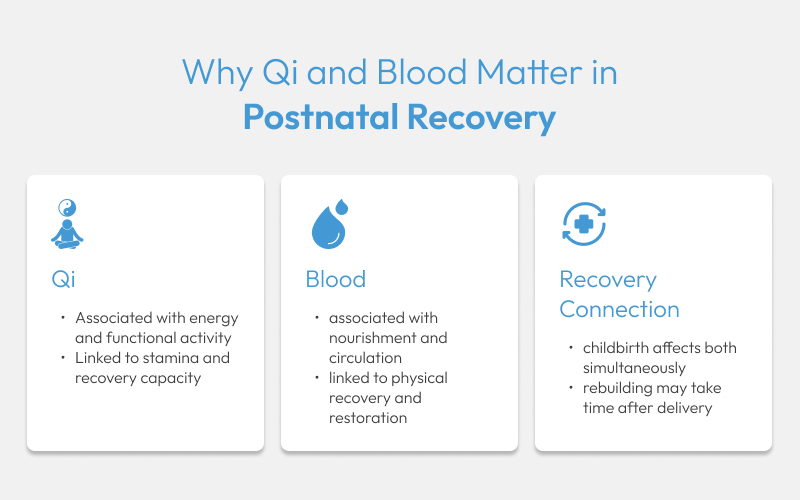
From a TCM perspective, childbirth places significant demands on both Qi and Blood. Labour involves prolonged physical exertion, while delivery itself entails considerable Blood loss. Since Qi and Blood are viewed as closely interconnected in TCM theory, depletion in one may impact the stability of the other, influencing the ease of recovery thereafter.
Consequently, postpartum recovery is frequently discussed in terms of overlapping patterns such as Qi deficiency, Blood deficiency, and Blood stasis, rather than as isolated symptoms that occur independently.
Qi deficiency may arise when the body’s energy reserves are depleted after childbirth. In TCM, the Spleen system plays a crucial role in transforming nourishment into Qi and Blood. When digestion weakens during recovery, the rebuilding of the body’s internal resources may also slow down. Some women may experience this as persistent fatigue, poor appetite, reduced stamina, bloating, or a lingering sense of heaviness despite resting.
Blood deficiency is often associated with symptoms such as dizziness, disrupted sleep, palpitations, dryness, emotional sensitivity, reduced resilience, and mental exhaustion. In TCM theory, Blood is not viewed solely in terms of circulation; it is also integral to how the body nourishes tissues and supports recovery after physical depletion. When Blood is insufficient, energy levels may fluctuate noticeably throughout the day, particularly during periods of stress, breastfeeding demands, or inadequate rest.
Simultaneously, circulation within the abdominal and pelvic regions is still adjusting after delivery. This may be understood in TCM as Blood stasis, especially when symptoms such as lingering soreness, abdominal tenderness, heaviness, or persistent discomfort extend beyond the early postpartum stage. Rather than viewing these symptoms in isolation, TCM approaches often interpret them as interconnected responses within a single recovery process.
This broader perspective also elucidates why postnatal symptoms may affect multiple systems simultaneously. Fatigue may occur alongside digestive changes, muscular tension may accompany disrupted sleep, and lower back weakness may arise alongside emotional strain or an irregular appetite. Within postnatal care, these patterns are often assessed collectively to better understand how the body continues to recover and redistribute its resources after childbirth.
Why Confinement Practices Remain Closely Linked to Recovery
Many traditional confinement practices are deeply rooted in TCM’s understanding of the body during the postpartum period. While confinement is often culturally recognised as a recovery tradition, TCM specifically views it as a phase in which the body is still rebuilding Qi, Blood, circulation, and physical resilience after childbirth. This perspective is one reason why postnatal care in TCM places a strong emphasis on warmth, rest, nourishment, and gradual recovery, rather than expecting the body to return quickly to its usual state.
After delivery, the body is considered temporarily weakened due to both physical exertion and Blood loss. During this stage, circulation and internal warmth may not yet be fully stabilised. This helps explain why cold foods, cold environments, excessive exposure to wind, and overexertion are traditionally discouraged during confinement. From a TCM perspective, cold is believed to impair circulation and place additional strain on a body still recovering from childbirth.
The emphasis on warmth is also closely linked to digestion. In TCM theory, the Spleen system plays a vital role in rebuilding Qi and Blood through nourishment. If digestion weakens during recovery, the body may struggle to convert food into the resources needed to support healing. Warm soups, slow-cooked meals, and easily digestible foods are commonly encouraged during confinement to support this rebuilding process.
This is also where herbal support may be introduced more intentionally. Rather than serving as general tonics, herbal soups and formulations are typically selected based on the individual’s constitution, digestion, circulation, recovery stage, and presenting symptoms.
Commonly discussed herbs include:
- Dang Gui (Angelica sinensis), traditionally associated with nourishing and moving Blood
- Huang Qi (Astragalus), often linked to supporting Qi and postnatal energy recovery
- Shu Di Huang (Rehmannia), commonly used in formulas for Blood replenishment and restorative support
These herbs are generally prescribed within broader formulations rather than used independently. TCM physicians may also adjust herbal prescriptions according to symptoms such as poor appetite, bloating, disrupted sleep, excessive fatigue, digestive sensitivity, or slower physical recovery.
Rest during confinement is similarly viewed through a broader lens than simply increasing sleep. From a TCM standpoint, excessive physical strain before the body has sufficiently rebuilt may prolong deficiency patterns and hinder recovery progression. For this reason, postnatal care is often approached progressively, with support adjusted according to how the body continues rebuilding after childbirth.
Common Body Changes After Giving Birth
Many women notice that certain physical changes persist well beyond the early postpartum stage. While some symptoms gradually improve over time, others may fluctuate depending on sleep quality, breastfeeding demands, emotional stress, physical workload, and the overall pace of recovery.
Common body changes may include ongoing fatigue, muscular tightness, lower back weakness, abdominal heaviness, disrupted sleep, appetite fluctuations, emotional sensitivity, hair shedding, and slower physical recovery. Within postnatal care, these ongoing adjustments are often monitored alongside changes in energy, circulation, digestion, and physical recovery.
From a TCM perspective, these symptoms are not typically viewed in isolation. For example, persistent fatigue may relate not only to disrupted sleep but also to the slower rebuilding of Qi and Blood following delivery. Similarly, lower back discomfort is commonly associated with the Kidney system in TCM, which is traditionally linked to reproductive recovery, constitutional strength, and postnatal restoration.
Breastfeeding also places ongoing demands on the body after childbirth. In TCM theory, milk production is closely connected to both Qi and Blood. This connection may explain why some women experience increased exhaustion, changes in appetite, or fluctuations in physical resilience as breastfeeding continues over time.
Hair shedding after childbirth may likewise be understood through Blood-related patterns in TCM, particularly when recovery is prolonged or when nourishment and rest are insufficient. Digestive symptoms such as bloating, poor appetite, or irregular eating patterns may also arise when the Spleen system is still recovering from physical depletion, disrupted routines, and ongoing fatigue.
Within postnatal care, symptoms are often assessed in relation to broader recovery patterns involving circulation, digestion, sleep, and physical recovery
How TCM Supports Recovery After Delivery
TCM approaches to postnatal recovery may include acupuncture, Tuina, herbal support, warming therapies, and recovery-focused bodywork, tailored to the individual’s symptoms, constitution, and stage of healing. In postnatal care, these methods are commonly employed to enhance circulation, restore Qi and Blood, alleviate physical strain, and facilitate gradual recovery after childbirth.
Instead of adhering to a fixed recovery protocol, TCM postnatal care is typically customised based on the body’s recovery progress over time. Factors such as fatigue, muscular tension, digestion, breastfeeding demands, sleep quality, circulation, and overall physical resilience are all considered when personalising support during the postpartum period.
Postnatal Tuina and Manual Therapy Approaches
Within TCM postpartum care, postnatal Tuina is commonly used to support physical recovery after childbirth. Unlike general relaxation massage, postnatal Tuina focuses more specifically on circulation, muscular strain, meridian pathways, and areas of the body that may still be recovering after pregnancy and labour.
Pregnancy often places sustained strain on the lower back, hips, shoulders, abdomen, and pelvic region. After delivery, these areas may continue carrying tension due to breastfeeding posture, lifting and carrying the baby, disrupted sleep positions, and the gradual return to daily activities. For some women, physical discomfort may become more noticeable as the demands of newborn care accumulate over time.
From a TCM perspective, muscular tightness is not viewed purely as a structural or muscular issue alone. Qi flow, Blood circulation, and overall recovery balance are also considered important factors influencing how tension settles, persists, or fluctuates throughout the postpartum period. Within postnatal care, muscular discomfort is often assessed alongside circulation, recovery progression, and overall physical strain after childbirth
Postnatal Tuina techniques are therefore typically applied using controlled pressure and adjusted according to the individual’s recovery stage. The abdominal region, for instance, is generally approached more cautiously during the earlier stages after childbirth, particularly following caesarean delivery or prolonged physical strain during labour.
For women exploring TCM postnatal massage, approaches are generally adjusted according to individual recovery needs and stage of healing
Breast Massage and Lactation Support
Breastfeeding can place ongoing physical demands on the body long after delivery. The repetitive feeding posture, carrying the baby, disrupted sleep, and prolonged tension across the chest and upper body can contribute to discomfort in the shoulders, neck, upper back, and breast region. Some women may also experience localised heaviness, sensitivity, tightness, or discomfort during feeding.
From a TCM perspective, breast-related discomfort is often addressed by regulating Qi and circulation, rather than focusing solely on the breast tissue itself. The chest region is closely associated with the movement of Qi and Blood circulation, along with overall postnatal recovery, may also influence how the body adapts during lactation.
This is one reason why some women seeking breast massage services after childbirth may be looking not only for localised relief but also for support in managing the broader physical demands associated with breastfeeding and postpartum recovery. Within postnatal care, breast-related discomfort is often assessed together with broader recovery patterns.
Acupoints commonly discussed in lactation-related care include SI1 (Shaoze) and CV17 (Shanzhong). SI1 is traditionally associated with lactation support, while CV17 is often linked to regulating Qi flow in the chest.
However, acupoint selection in TCM is not fixed. Treatment approaches are generally tailored to the individual’s overall presentation, including whether symptoms occur alongside fatigue, emotional strain, poor circulation, muscular tightness, or slower postnatal recovery.
Acupuncture and Acupoint Selection After Childbirth
Acupuncture can be an integral part of postnatal recovery support when symptoms such as fatigue, disrupted sleep, muscular tension, abdominal discomfort, or slower physical recovery persist after childbirth.
In TCM, acupuncture selection is based on pattern differentiation rather than treating symptoms in isolation. This means that acupoints are chosen according to how Qi, Blood, circulation, digestion, emotional strain, and constitutional weaknesses interact throughout the recovery process. As a result, two women experiencing similar symptoms post-childbirth may receive different treatment approaches based on their overall presentation.
Some acupoints commonly used after childbirth include SP6 (Sanyinjiao), ST36 (Zusanli), and CV4 (Guanyuan).
SP6 (Sanyinjiao) is frequently highlighted in postnatal TCM because it intersects the Spleen, Liver, and Kidney meridians, which are traditionally associated with Blood regulation, digestion, reproductive recovery, and overall constitutional restoration after childbirth. SP6 may be considered when recovery involves both fatigue and circulation-related patterns after childbirth
ST36 (Zusanli) is often linked with digestive strength and Qi replenishment. This point may be considered when symptoms such as poor appetite, exhaustion, reduced stamina, or prolonged weakness continue affecting recovery. This connection explains why ST36 may be chosen when symptoms such as poor appetite, exhaustion, reduced stamina, or prolonged weakness continue to hinder recovery.
CV4 (Guanyuan), located on the lower abdomen, is traditionally associated with foundational Qi, reproductive recovery, and restoration following physical depletion. In postnatal care, emphasis on the lower abdominal region reflects the understanding that postpartum recovery involves not only structural healing but also the gradual stabilisation of circulation and internal balance after childbirth.
Rather than functioning as isolated techniques, acupuncture approaches in postnatal TCM are typically integrated within a broader assessment that considers the stage of recovery, breastfeeding demands, digestion, sleep quality, emotional wellbeing, circulation, and overall physical resilience.
Why Recovery Does Not Always Follow a Fixed Timeline
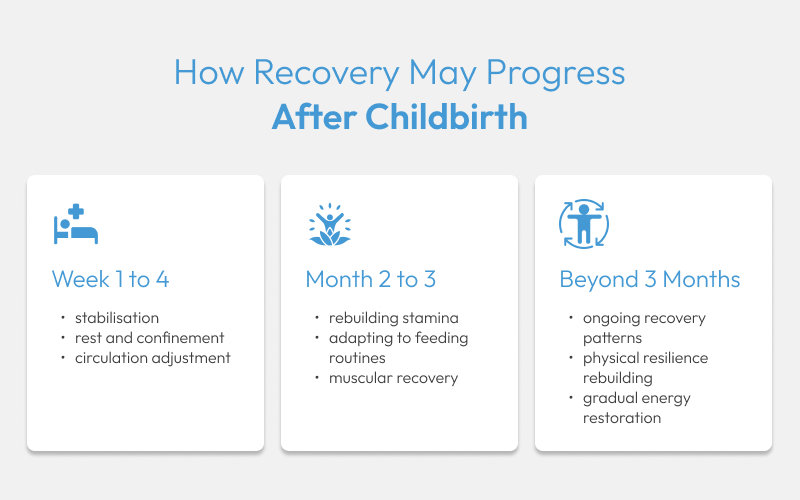
Postnatal recovery is often perceived socially as concluding after confinement. However, from a TCM perspective, recovery is seen as an ongoing adjustment process that may continue for several months following delivery.
The first month typically focuses on stabilisation. During this stage, the body is still recovering from labour while adapting to blood loss, physical strain, breastfeeding demands, and disrupted sleep patterns.
The following one to two months often shift towards rebuilding. As daily activities increase, some women may find that fatigue, muscular tension, or lower back weakness become more pronounced rather than dissipating entirely. Physical demands frequently escalate during this stage, even as internal recovery remains ongoing.
Longer-term recovery after delivery can fluctuate based on factors such as workload, sleep quality, emotional strain, breastfeeding, digestion, and overall constitution. While some women steadily regain their strength, others may experience periods where symptoms temporarily worsen due to physical or emotional stress.
This is one reason why TCM approaches postnatal care as a progressive recovery process rather than a short-term milestone.
When Should You Consider Additional Postnatal Support?
Some postnatal symptoms gradually improve over time, while others may persist longer than expected or continue to affect daily routines during recovery.
Further assessment may be worth considering if you notice:
- persistent fatigue months after childbirth
- lingering abdominal discomfort or heaviness
- significant lower back strain
- muscular tightness affecting movement or posture
- disrupted sleep continuing beyond the early postpartum stage
- difficulty rebuilding stamina despite rest and recovery efforts
When these symptoms continue affecting comfort, mobility, sleep, or overall energy levels, further assessment may help provide better insight into the recovery process
Frequently Asked Questions About Postnatal Care
How long does postnatal recovery usually take?
Postnatal recovery timelines can vary considerably between individuals. While confinement is typically associated with the first month after childbirth, physical recovery, hormonal adjustment, and the rebuilding of Qi and Blood may continue for several months. This duration depends on factors such as sleep quality, breastfeeding demands, emotional stress, workload, and overall recovery capacity.
Are confinement practices still relevant today?
Many modern confinement practices continue to reflect traditional TCM principles centred on warmth, digestion, circulation, rest, and gradual recovery after childbirth. Although routines may differ between households today, the overarching concept of protecting the body during its rebuilding phase remains closely linked to postpartum recovery in TCM.
Can TCM postnatal care be combined with hospital follow-up care?
TCM approaches are frequently used alongside conventional postnatal care and medical follow-up. Treatment plans are typically adjusted according to the individual’s recovery stage, symptoms, physical condition, and any ongoing medical care following childbirth.
Why do some women continue feeling physically weak months after delivery?
From a TCM perspective, childbirth can continue to affect Qi, Blood, digestion, circulation, and overall recovery balance well beyond the early postpartum stage. Ongoing fatigue or weakness may therefore reflect a combination of physical depletion, disrupted sleep, breastfeeding demands, emotional strain, and a slower internal recovery process over time. This is one reason ongoing support may still form part of TCM approaches to women’s health after childbirth.
Are herbal baths only used during confinement?
Not necessarily. While warming herbal baths are strongly associated with confinement practices, some women continue to incorporate them later in their recovery to support circulation, relaxation, and muscular comfort as daily physical demands increase. Approaches involving herbal baths during confinement may also vary depending on the individual’s recovery stage and overall condition.
Supporting Recovery Beyond the Confinement Period
Postnatal recovery seldom follows a predictable trajectory. Even after the confinement period concludes, the body continues to adjust to physical strain, hormonal fluctuations, disrupted sleep, breastfeeding demands, and the ongoing responsibilities of caring for a newborn.
Within TCM, postnatal care emphasises support for this extended rebuilding process. It adopts a holistic approach that considers Qi, Blood, circulation, digestion, muscular recovery, and emotional wellbeing as interconnected rather than isolated issues.
At 1TCM, our postnatal consultations focus on understanding how your body is recovering after childbirth and identifying areas that may still require additional support. Whether you are experiencing ongoing fatigue, physical tension, or a slower recovery after delivery, our physicians tailor care to suit your current condition and stage of recovery.
For a more personalised understanding of your postnatal recovery journey, schedule a consultation with 1TCM today.
